
Finding Lake County Residents
Lake County does not maintain one complete resident roll. Start with a known name, address, or approximate year, then choose the office that records that relationship. The Auditor is the practical start for a parcel or owner question. The Recorder is stronger for a deed or document relationship. The Board of Elections is a name-first registration service. Morley Library holds the historical directory, newspaper, census, and obituary material that gives an old household a date.
A result still needs context. A recorded owner can use a different mailing address. A voter record is not a street-browse list. A directory entry captures what its publisher printed for one edition. Treat each as a dated fact, then seek another independent record when the identity matters.
- For an address, search the Lake County Auditor property portal for the parcel, street, or owner.
- Open the parcel in Lake Navigator to compare the physical address, community, legal description, and map setting.
- Use the legal description or party name in the Recorder search routes to follow recorded instruments.
- For a name-first check, use the Lake Board of Elections lookup and compare only the information it lawfully releases.
- For an earlier year, request a focused search from Morley Library genealogy staff or consult its collections by appointment.
Lake County Records Offices
Different Lake County offices preserve different kinds of evidence. The records below are useful because their custodian and scope are clear. A parcel search, a recorded deed, and a registration result should never be collapsed into a claim that every person at an address has been identified. The address-focused process is developed on the Lake County street directory.
Lake County Recorder
105 Main Street, Painesville, OH 44077
440-350-2510
Lake County Auditor
105 Main Street, Suite C101, Painesville, OH 44077
440-350-2532
Basic Property Search
Lake Board of Elections
105 Main Street, Suite 107, Painesville, OH 44077
440-350-2700
Lake County Address Records
The Auditor’s search is the best Lake County entry point when an address is known. It accepts a parcel ID, owner, address number, street, and Postal Code. Its own instructions say to leave off the street suffix for the best street search and permit an asterisk wildcard. That makes an uncertain spelling or a whole street practical to inspect without pretending that the results are a household list.
| Auditor field | Use | Lake County note |
|---|---|---|
| Parcel ID | Find a known parcel | An asterisk can return a group of parcel IDs. |
| Owner | Check recorded-deed spelling | Partial names and wildcard patterns are supported. |
| Address No. and Street | Locate the situs address | Omit suffix; an uncertain street can use a wildcard. |
| Postal Code | Narrow parcel results | It is a property-search component, not a person filter. |
The GIS data service distinguishes the situs address from owner-mailing and taxpayer fields. It also provides parcel, community, school-district, subdivision, value, and sale context. That distinction matters in a Lake County residents directory because a tax contact can be elsewhere and a parcel record does not identify every occupant.
See the official Auditor search before running a street or owner query.
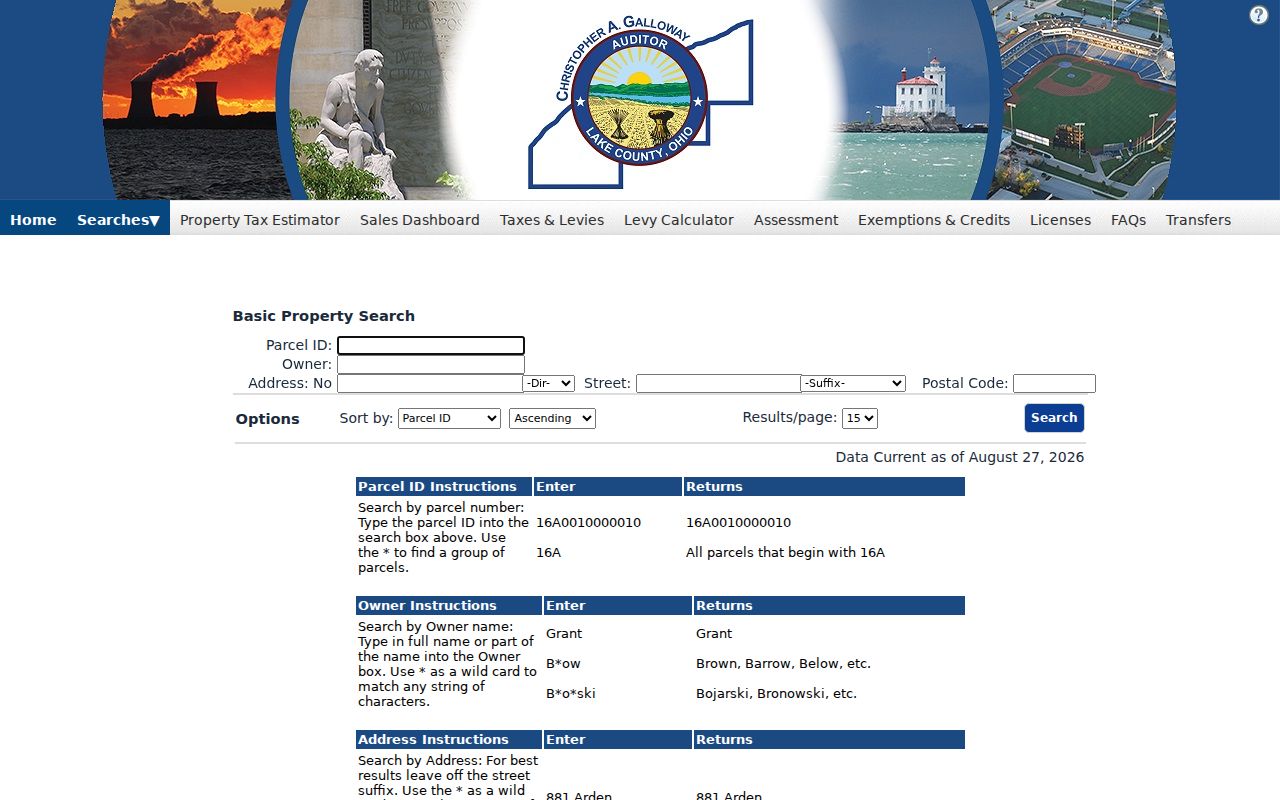
The property-search screen illustrates the address and owner starting points that lead to a parcel record, rather than a complete list of residents.
Lake County Deed Records
Once a parcel is identified, the Recorder adds the document layer. Its AVA route is described as basic information, while Laredo Select is the advanced route and requires registration and a password. The office says its online index begins in 1986 and its online images begin in 1987. Older instruments are not erased by that boundary. The Recorder keeps the county’s first deed, recorded April 16, 1840, and supports counter research, mail copies, and specific public-record requests.
For a document not online, the Recorder publishes a hard-copy route at $2 per page: mail a check and a self-addressed stamped envelope, or visit the office during its stated weekday hours. Its public-records mailbox is another route for a particular existing instrument. Use the document type, parties, recording date, and legal description as the research trail. A deed, affidavit, plat, lien, or transfer-on-death document has a different purpose.
The Recorder’s official site introduces the AVA and Laredo paths.
The Recorder’s routes are a document trail, useful for dated property relationships rather than a present-tense resident claim.
Lake County Resident Sources
Current-looking Lake County sources answer narrow questions. The table identifies what each can actually corroborate and where its limits begin. Direct official sources are easier to audit than a commercial directory because their keeper, record date, and access rules are visible.
| Official Lake County or Ohio record | Commercial people-finder category |
|---|---|
| The custodian, record type, stated coverage, and correction path can be checked against the Auditor, Recorder, Clerk, elections office, library, or state program. | The source date, update method, and basis for a combined profile may be unclear. It cannot replace a record held by the actual custodian. |
| A result can be limited to the question the record was created to answer, such as a parcel, court case, voter registration, or historic directory entry. | A broad result may combine different people, dates, addresses, and record types. Compare any lead with dated official evidence before relying on it. |
| Record source | What it may show | Custodian | Access route |
|---|---|---|---|
| Property roll | Parcel, owner, situs and mailing distinctions | Auditor | Free property portal or Real Estate Department |
| Recorded index | Parties, document type, legal property relationship | Recorder | AVA, Laredo, counter, mail, or request |
| Voter record | Registration and precinct context released by law | Board of Elections | Name-first local or state lookup |
| Court index | Case-party and docket context | Clerk of Courts | ShowCase and document-request routes |
| Historic directory | Printed householder or address listing for one edition | Morley Library | Appointment, focused request, and onsite research |
When a name needs careful corroboration, compare records one by one. Neither a registration hit nor a property result should be treated as a complete biography.
Lake County Voter Checks
Ohio voter records are useful for a limited registration question. The local Lake Board of Elections form asks for first and last name, and the statewide lookup asks for first name, last name, and county. R.C. 3503.13 and R.C. 3503.153 govern what is public. Registration, residence, precinct, registration date, and voting-history fields are subject to stated exclusions. Voting history records participation information, not ballot choices.
There is no verified public Lake County tool that returns everyone on a street. Protected fields include sensitive identifiers and contact data, and Safe at Home participants use confidential registration. A no-result may reflect a former surname, a move, a confidentiality rule, an input variation, or nonregistration. It does not settle whether a person lives in Lake County.
Use the Ohio voter lookup as a name-and-county service, then ask the Board about an existing record or list-inspection procedure when that is the proper channel.
Lake County Vital Record Routes
Birth and death certificates use a different Lake County channel from a property or voter search. The Lake County General Health District issues Ohio birth certificates and Ohio death certificates through its Vital Statistics office. It accepts walk-in, mail, telephone, and email-assisted payment requests, but certificates are not sent by email or fax. A historical name search may instead start with the Ohio History Connection death index, whose published indexed runs are not a complete substitute for a current certificate request.
Lake County Probate Court maintains marriage-license and certified marriage-certificate functions. Divorce and dissolution files belong with the Clerk of Courts. These separate custodians matter when a dated family event is being verified. For a death certificate less than five years old, the Health District explains that the certificate omits the Social Security number unless the required non-redacted process and relationship documentation are provided.
Lake County General Health District Vital Statistics publishes the local certificate-request routes and current ordering details.
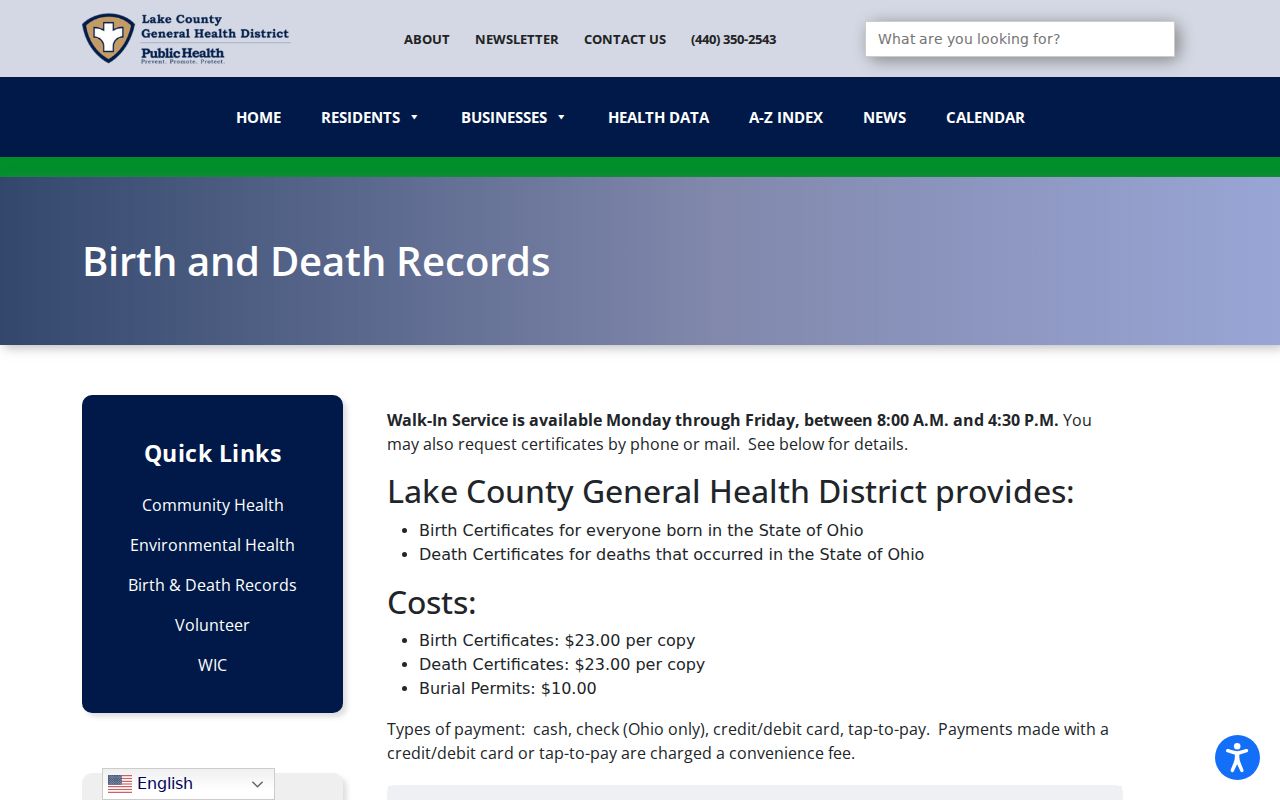
The Health District screen is a request source for certified records, not a searchable list of Lake County residents.
Lake County Court Context
The Clerk’s ShowCase court search is a case-index route, not a general directory. The Clerk says public case search reaches 1990 forward and public document images reach 2017 forward, with Domestic Relations images excluded. A party name, case number, court type, status, and docket date can help distinguish people with the same name, but only when compared to another dated record.
Lake County Probate Court is a separate keeper for estates, guardianships, and marriage-record functions. If an online image is unavailable, the Clerk accepts a document-specific request at PublicRecords@LakeCountyOhio.gov. Its policy gives the case-number route, or for a divorce or dissolution without a number, both married names and the year. Non-certified PDFs can be emailed without charge; physical and certified copies follow the stated copy policy.
Question: Does a court result prove a current address? No. It establishes case context and dates, while a current residence requires its own lawful, time-consistent evidence.
Open the Clerk ShowCase interface to see its available filters.
The court screen is a distinct case channel, not a replacement for parcel, Recorder, or library research.
Lake County Historical Directories
Morley Library is the core Lake County historical-directory shelf. Its Painesville runs include 1895, 1902, 1906, 1908, 1911, 1923, 1929, and 1930. The 1923 held volume is the first Painesville directory with street-address listings. Later Painesville-Mentor editions run from 1966 through 1990, and Haines Lake-Geauga criss-cross volumes provide an address-to-listed-occupant route for the years Morley holds.
A historical listing is valuable because it has a publication year. It can preserve a name, initials, occupation or affiliation wording, and a printed address. It is not proof of a current address, ownership, or every household member. The full holdings and entry-reading method belong in the Lake County city directory collections.
Morley’s city-directory holdings page is the source for the collection list.
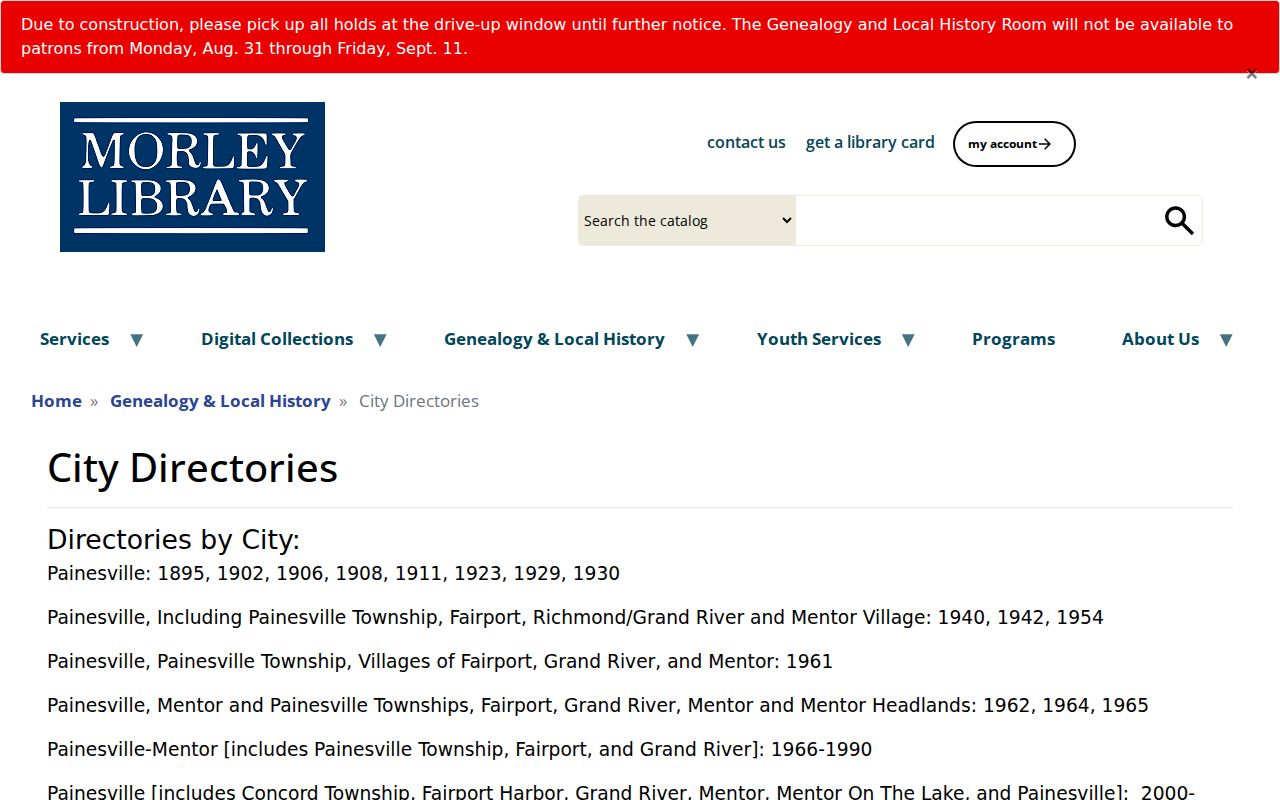
The library collection provides a source-dated historical trail when a modern online index stops.
Lake County Record Terms
Small record labels prevent large mistakes. Lake County systems use address and land terms that may look similar while describing different things. Keep the source’s wording in notes and compare it with the record date.
- Parcel
- A county-defined piece of property identified by a PIN or parcel ID, used to join map and Auditor data.
- Situs address
- The physical address of the property, distinct from owner-mailing and taxpayer addresses.
- Index
- A searchable record list that can point to a document, but may not contain the image itself.
- Criss-cross directory
- An address-first directory arrangement that helps locate the person or business printed at an address for its edition.
Lake Navigator and the Auditor display related fields, but the county cautions that GIS parcel lines are not legal surveys. For a boundary question, use the appropriate survey or legal process rather than a mapped line.
Lake County Record Access Timeline
Lake County’s digital records do not all begin at the same point. The Recorder says its office was established in 1840 and that the first county deed was recorded that year, but its online index begins in 1986 and public images begin in 1987. A combined record system began in 1983 and scanning began in 1996. Those dates explain why a search can find a later document online while an older parcel history needs a book, counter visit, mail copy, or record-specific request.
- 1840: Lake County’s Recorder was established and the first county deed was recorded.
- 1983: the Recorder began its combined record system.
- 1986 and 1987: the published online index and image coverage begin, respectively.
- 1996: the Recorder reports the beginning of digital scanning.
Early Lake County research may also belong in a predecessor jurisdiction. Trumbull County covered the area from 1800 to 1806, Geauga County from 1806 to 1840, and Cuyahoga County handled Willoughby-area history from 1810 to 1840. The place and year should determine the next archive, not a modern county label alone. At each handoff, preserve the source, office, date range, and record type in the research notes.
Lake County Online Gaps
An online miss is often an access question, not a negative finding. The Recorder’s online index begins in 1986 and images in 1987, even though its deed history begins in 1840. Morley has federal census microfilm for Lake County for 1840-1880 and 1900-1930, while the 1890 population census was largely destroyed. The Lake County Historical Society adds ownership histories, maps, telephone directories, surname files, and a catalog through an appointment-based research process.
Older geography can also lead outside the modern county. Lake County’s predecessor jurisdictions were Trumbull County from 1800-1806, Geauga County from 1806-1840, and Cuyahoga County for Willoughby from 1810-1840. Use the place and period before concluding that an early family or land reference has no record.
Explore the Lake County Historical Society research library for the appointment and research-service path.
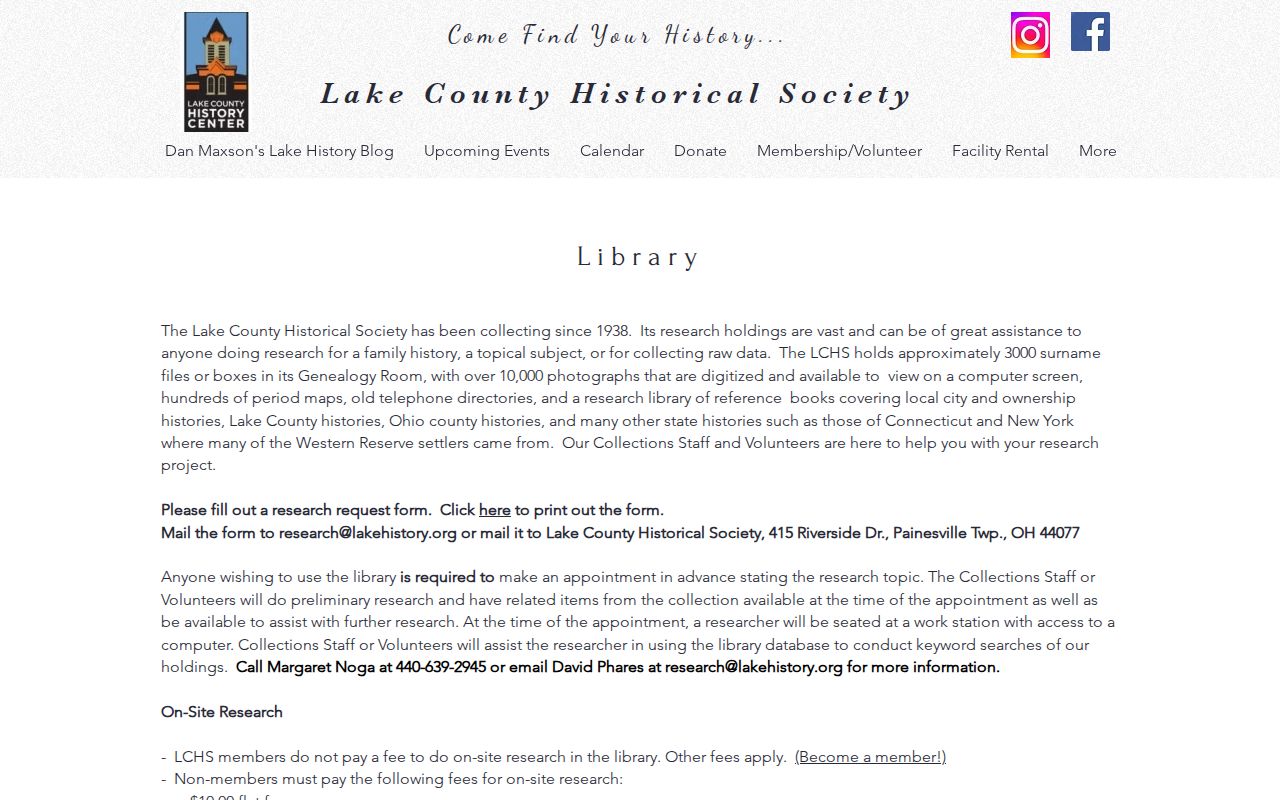
The Historical Society offers a documented archive alternative when parcel, Recorder, and library research needs local context.
Note: A missing online image can mean the record is older, restricted, or held in another series, not that the event never occurred.
Lake County Request Routes
Ohio’s Public Records Act, R.C. 149.43, governs existing public records held by public offices, subject to exceptions. A request does not need a written form. When a request is unclear, the custodian must offer an opportunity to revise it by explaining how the office keeps and accesses the records. A useful request identifies the record type, name or address, date range, and preferred copy format rather than asking an office to create a new resident list.
Send land-instrument questions to the Recorder, parcel questions to the Auditor, case requests to the Clerk, historical collection questions to Morley or the Historical Society, and municipal records to the relevant city custodian. For example, Painesville’s official-records page directs older Council items to its Clerk of Council. Painesville Code Enforcement describes address-based functions but no public name-or-address case index was found, making a targeted existing-record request the honest route.
Review the Clerk’s public-record request instructions for a Lake County example of a specific document route.
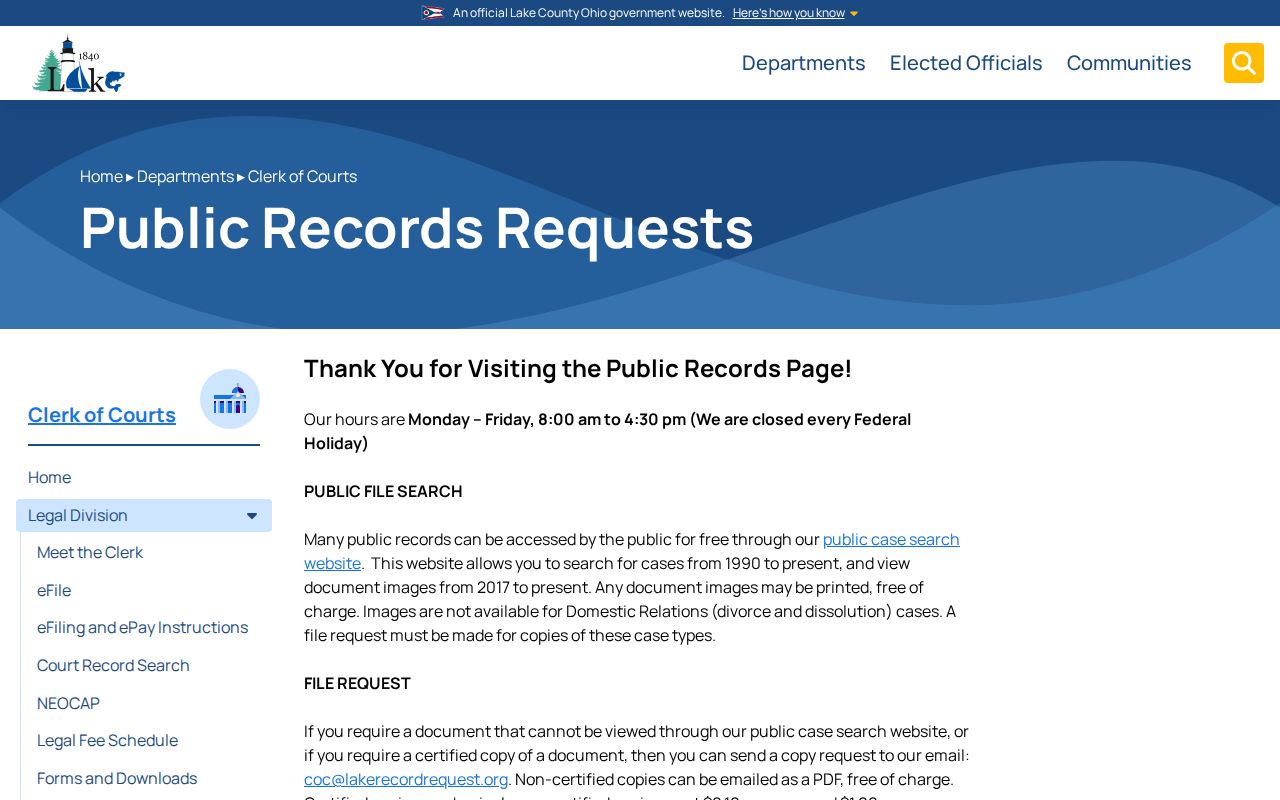
A request channel supplements an online search when the needed record, copy, or year is not displayed publicly.
Lake County Privacy Limits
Public availability has firm boundaries. Ohio excludes or limits medical material, adoption files, sealed or expunged court material, confidential investigatory information, protected voter data, and Safe at Home information. A limited parcel display or a missing registration record can be a lawful safety protection. It is not an invitation to look for another route to the protected information.
Safe at Home Ohio supplies a substitute-address process for qualifying people facing safety risks. R.C. 111.431 also provides a real-property confidentiality-notice route. R.C. 149.45 addresses qualifying personal-information redaction in public records. Corrections belong with the custodian that maintains the specific field or document, not with an unrelated office.
The Safe at Home Ohio program explains the protected-address application route.