
Lake County City Directory Runs
Morley Library is the verified starting shelf for Lake County city directories. Its holdings are organized by title and geographic reach, so the volume name matters as much as the year. Early Painesville books are strongest for a name-to-address search. The 1923 Painesville book is the first held volume with street-address listings, which changes the question that the book can answer. Later Painesville-Mentor volumes and the Haines books add a more direct address route. Check the title page and the published holdings list rather than assigning an unverified publisher to an early volume.
| Collection | Years | Where Held | Access |
|---|---|---|---|
| Painesville directories | 1895, 1902, 1906, 1908, 1911, 1923, 1929, 1930 | Morley Library Genealogy and Local History Room | Appointment or focused request |
| Expanded Painesville-area directories | 1940, 1942, 1954, 1961, 1962, 1964, 1965 | Morley Library | Consult the named community coverage |
| Painesville-Mentor directories | 1966-1990 | Morley Library | Sequential editions for comparison |
| Lake County directories | 1924, 1926, 1928, 1996-1998 | Morley Library | Broader county layer |
| Haines & Co. Lake-Geauga criss-cross | 1976, 1977, 1981-1987, 1989, 1991 onward | Morley Library | Address-to-listed-occupant research |
The collection also has a western-county run for Willoughby, Willowick, and Wickliffe, with Eastlake beginning in the 1964 volume. A missing name in a book does not automatically mean a move. Coverage, title, spelling, and household conventions can all change between editions. Note: A printed listing is evidence for that publication year, not proof of current residence or ownership.
Morley’s Lake County Directory Shelf
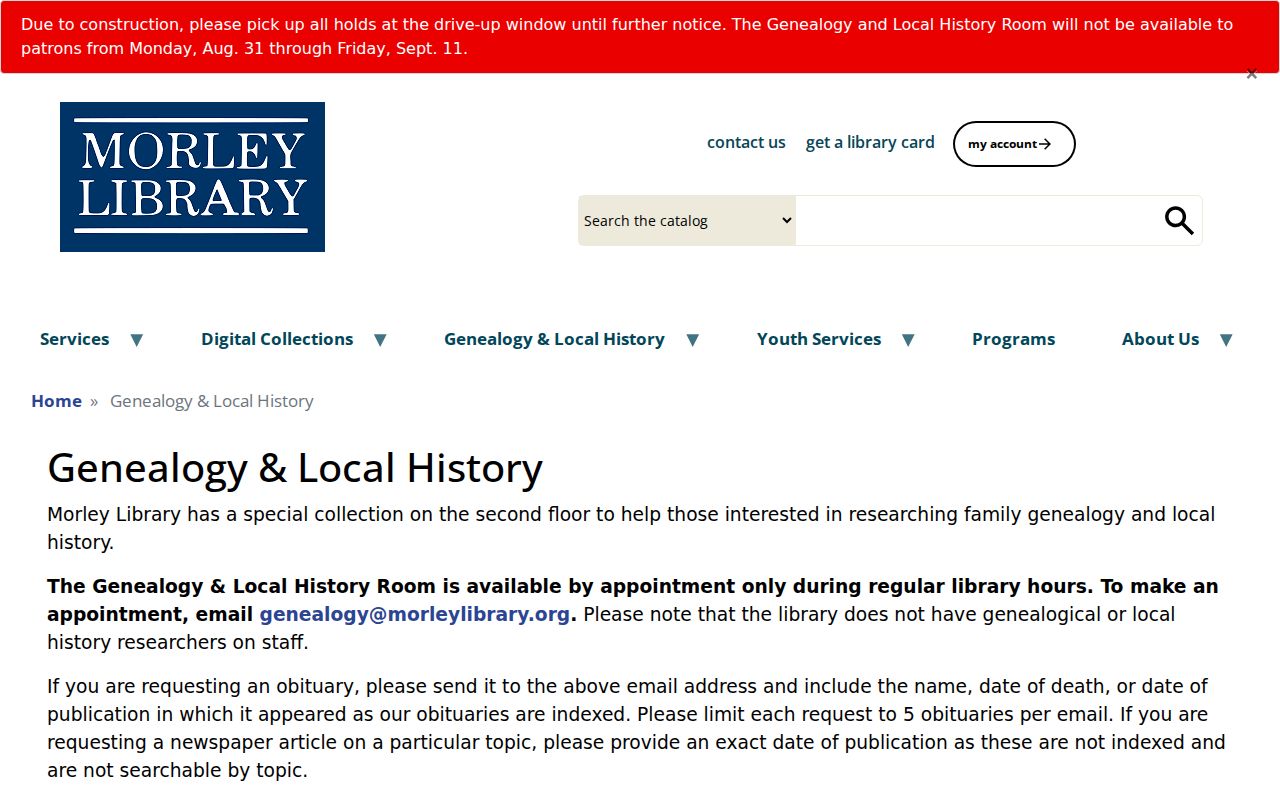
Morley’s Genealogy and Local History Room is on the second floor at 184 Phelps Street in Painesville. The room is appointment-only during regular library hours. A request can go to Morley’s genealogy service by email at genealogy@morleylibrary.org or by phone at 440-352-3383. Give a person’s name, an approximate year, the geographic area, and the kind of source needed. Morley says it has no dedicated genealogy or local-history researchers, and its part-time response queue commonly takes three to five business days.
Morley’s genealogy page identifies the local-history route and its appointment requirement.
The directory shelf belongs beside the library’s census microfilm, obituary index, newspapers, yearbooks, cemetery material, and selected telephone books. That mix helps test a date-specific directory result instead of treating a one-line entry as a complete family record.
1906 Lake County Directory Evidence
The digitized 1906-07 Painesville transcription is a useful local capsule, not a modern record. It derives from a 129-page directory associated with the 1907 Courthouse capsule and has individual and non-individual indexes. Its general material includes citizens, classified businesses, a short Painesville history, and street, school, and church directories. The transcription is especially valuable when a surname has a likely alternate spelling, but the source page should remain with the research note.
Its two index paths deserve different treatment. An individual entry can point to a person and a printed address, while a non-individual listing may identify a business, institution, church, or local service. Neither converts an organization reference into a household record. Copy the heading, source page, place name, and publication year with the result. Those details make it possible to compare the transcription with a nearby directory issue, newspaper notice, map, or deed without turning a useful lead into a claim the source does not support.
The 1906-07 Painesville directory transcription supplies an online view of this specific historical publication.
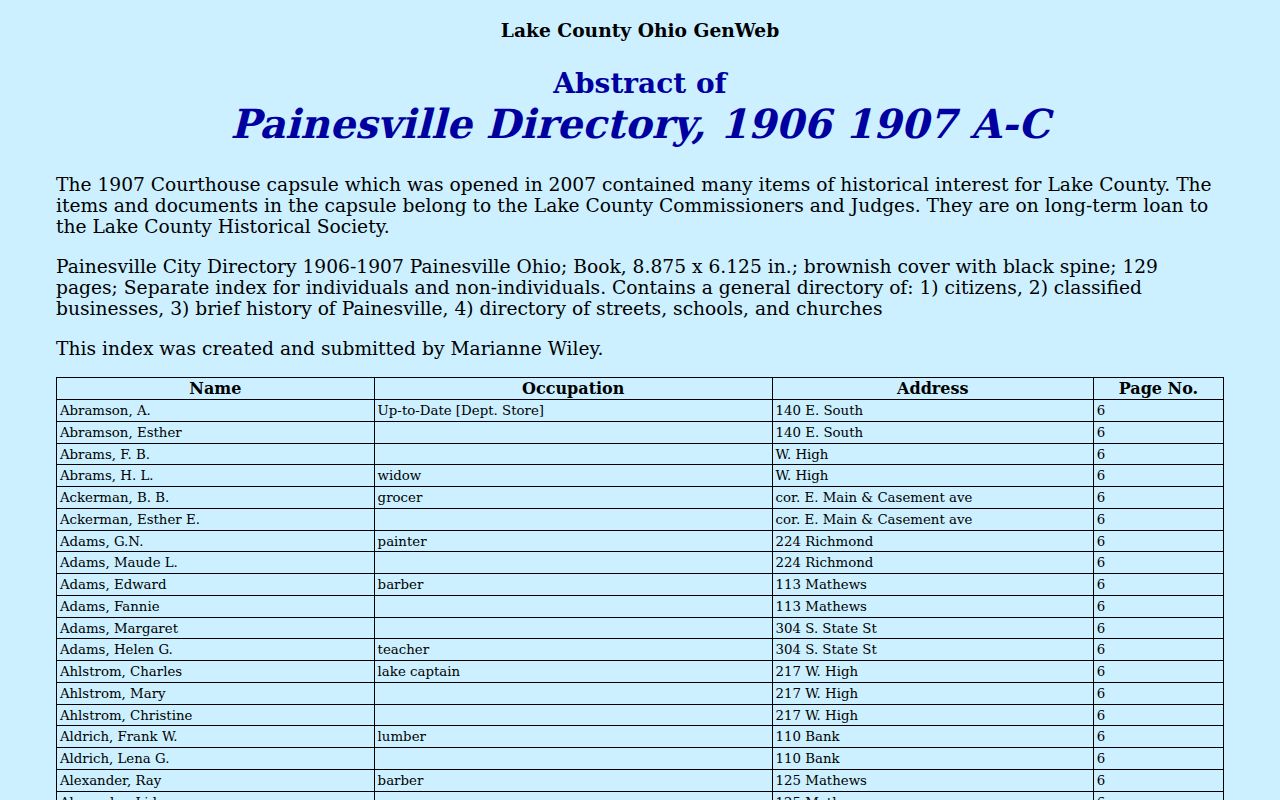
Use the transcription to locate a page, then label the result with its 1906-07 source date. Retain the volume title with every extracted entry. An old occupation or address describes the publication’s entry, not a present-day fact about that person.
Reading Lake County City Directory Entries
Entries should be copied as printed before they are interpreted. The local 1906-07 transcription shows surname-first names, occupations or affiliations, street addresses, and source-page pointers. It can also place several people at one address. That proximity is a useful household clue, but it does not establish a legal relationship. Widow wording and visible corrections are equally valuable because they can lead to probate, obituary, cemetery, or census research without overstating what the directory proves.
| Name | Copy the surname-first form, such as Charles Ahlstrom, and retain initials. |
|---|---|
| Occupation | Record the printed role or affiliation, such as lake captain or factory worker. |
| Address | Preserve the number and historic street form, such as 217 W. High. |
| Page | Keep the source-page pointer, such as page 6, with the entry. |
| Household clue | Note other listed people at the address without assuming their relationship. |
| Widow or variant | Capture wording such as “widow” and visible forms such as Braclay [Barclay]. |
A spelling variation can be the key to a second record. Search the printed form and the correction form separately, then compare year, place, and address before joining them.
Lake County Directory Terms
Directory language changes the path through the book. Read its opening pages and its key before copying shorthand into a family file. The Haines volumes are particularly useful because they reverse the usual name-first order. That makes them a later-period bridge between a known address and the person printed there in that edition.
- Criss-cross directory
- An address-ordered directory. Morley’s Haines Lake-Geauga books provide this route for their held years.
- Householder index
- A name-led listing centered on the person or household named in the publication, not a complete resident roster.
- Abbreviation key
- The volume’s explanation of its shorthand. Photograph or transcribe it before interpreting an entry.
For a present parcel, use the county’s Lake County street-address directory path instead. It begins with the Auditor and GIS, where a parcel record and its legal description can be checked without turning a historical listing into a current claim.
Lake County City Directory Timeline
Morley’s exact holdings set the practical timeline. The earliest held Painesville volume is 1895. The next held early volumes are 1902, 1906, 1908, and 1911. The collection identifies 1923 as its first Painesville directory with street addresses. Later title changes enlarge the named communities, so a researcher should read the cover and title page before treating two adjacent years as like-for-like coverage.
- 1895: oldest known held Painesville directory in Morley’s series.
- 1923: first held Painesville directory with a street-address section.
- 1966-1990: Painesville-Mentor editions permit comparison across sequential issues.
- 1976 onward, with held gaps: Haines criss-cross books supply the address-first layer.
The date is not decoration. Painesville, Fairport, Richmond or Grand River, Mentor Village, and Mentor Headlands appear in different title combinations across the runs. A no-result may be a coverage issue rather than evidence that a person left Lake County.
Trace Lake County City Directories
A careful household trail uses short, dated steps. Start with the ordinary directory nearest the known event. Preserve the surname variants, initials, street number, street name, occupation, and page. When the relevant edition has a street list, or when a Haines volume covers the period, look back from the address to the printed listing. A first or last appearance narrows a time window, but it cannot establish an exact moving date because the runs are not annual and their coverage shifts.
- Search the name under the volume’s community title and try a documented spelling variant.
- Save the entry and source page with the volume year.
- Compare nearby held directory years, including the street or criss-cross section when available.
- Pair the address with Morley’s Lake County census microfilm for 1840-1880 or 1900-1930.
- Use an obituary, cemetery, probate, or state death-index source to close a dated trail.
The federal 1890 population census was largely destroyed. Morley’s Northeast Ohio 1890 Union Civil War Pensioners/Widows schedule is a limited local workaround, not a substitute for the population census. Note: A disappearance from one directory can reflect coverage or listing practice as well as a move or death.
Lake County Directory Companions
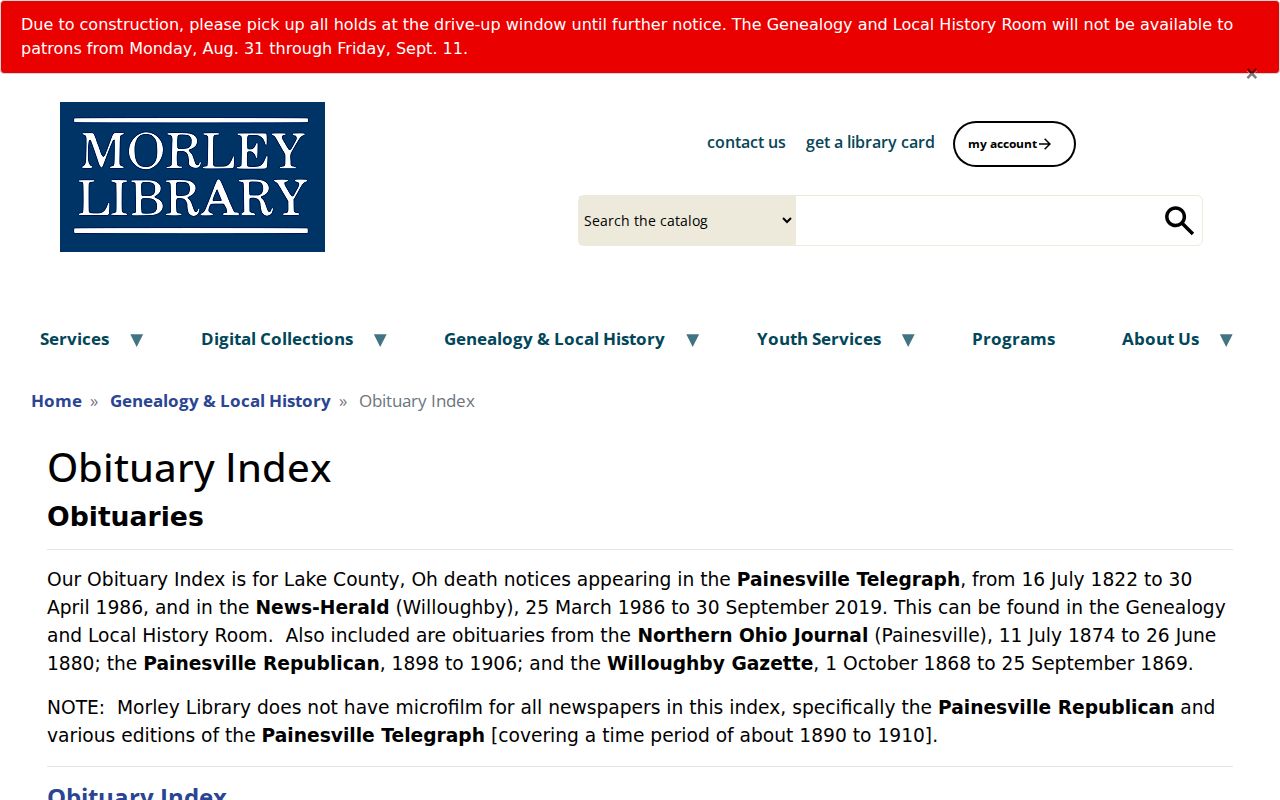
Morley’s newspaper and obituary resources can supply the dates that a city directory leaves open. Its obituary index covers the Painesville Telegraph from 1822 to 1986 and the News-Herald from 1986 to 2019, with additional named local papers. A request by email, phone, or mail should state the full name, death date, publication date when known, and paper or electronic preference. Morley limits obituary requests to four people at once and notes that some indexed items lack available microfilm.
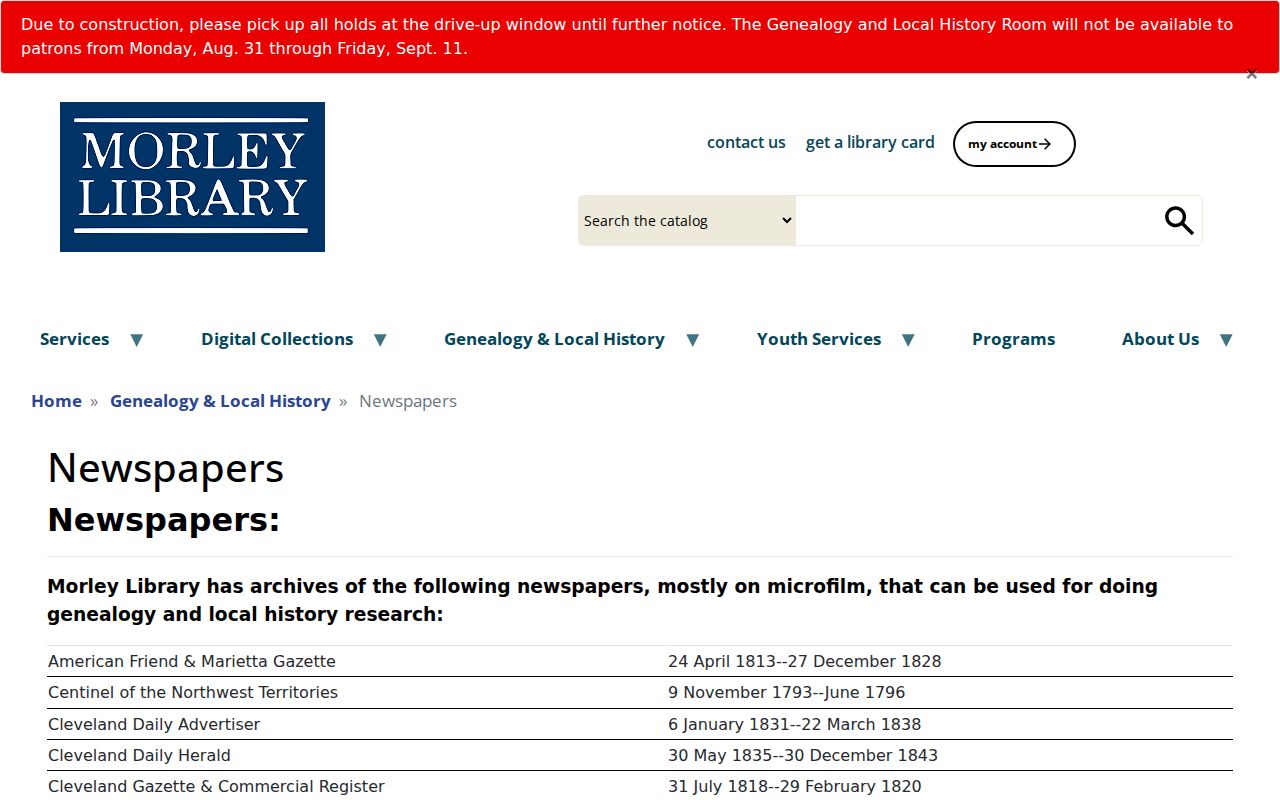
Morley’s historical-newspaper holdings document the available paper runs.
For the physical setting, use the county’s historic Tax Map atlases or Painesville Sanborn editions. Maps can check a road, village name, and building footprint, but they do not prove title or household membership.
Morley’s obituary-index service is the source for the locally described request method.
An obituary result can help bound a historical trail. It should be cited as a dated notice, not used to infer a current address for anyone named in it.
Lake County Directory Archive Alternative
The Lake County Historical Society is the stronger archive fallback when a directory question needs maps, an old telephone book, a local history, an ownership-history lead, or surname material. Its research library reports about 3,000 surname files or boxes, more than 10,000 digitized photographs viewable at a computer, hundreds of period maps, and an online catalog of more than 31,000 objects. It requires an advance appointment and preliminary topic statement at 415 Riverside Drive, Painesville Township. Contact research@lakehistory.org or 440-639-2945.
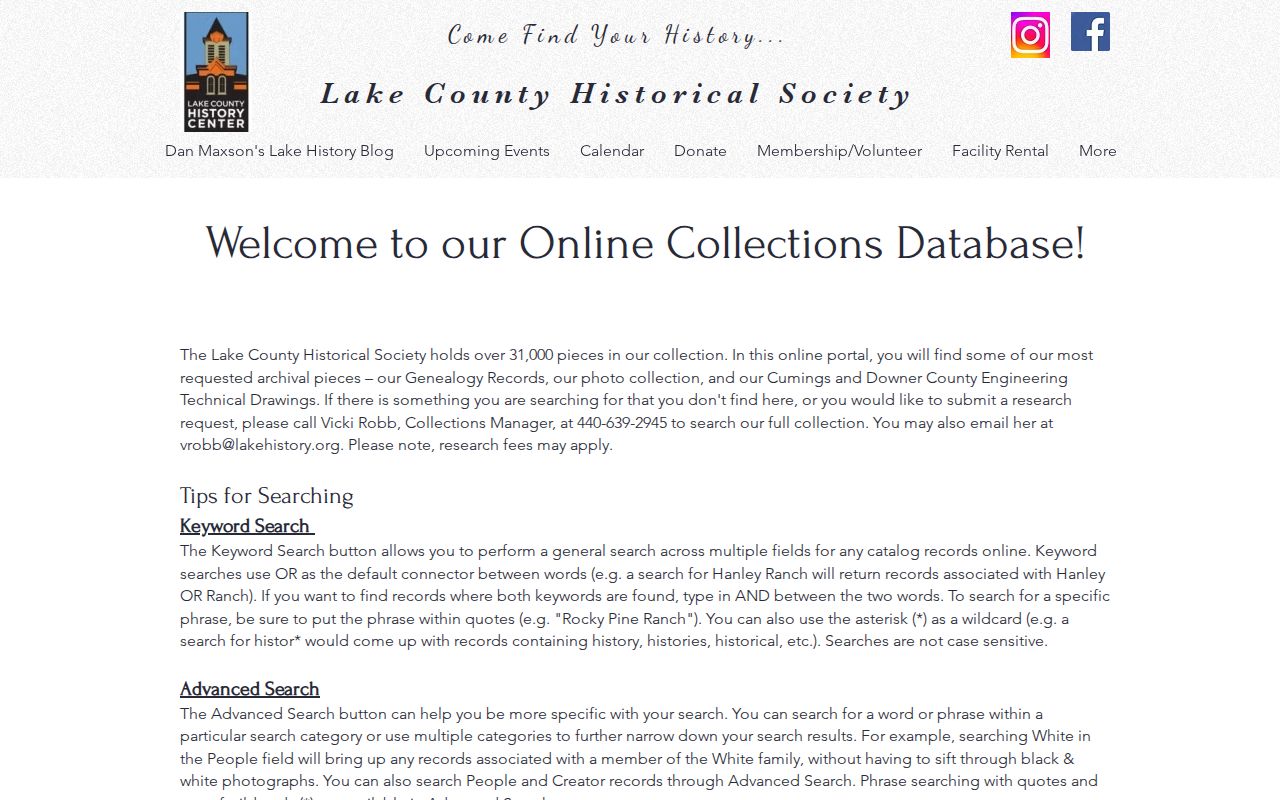
The Historical Society online collections database offers quoted-phrase, uppercase AND, wildcard, and advanced field or category searching.
Nonmember on-site research costs $10 for adults and $3 for students. Remote staff research is $25 per hour, copies are $0.50, and image reproduction has published fees. This archive can interpret local context, while the original directory remains the evidence for its own date and printed listing.
Note: The collection needs an appointment and a defined topic, so name the place, volume year, and source type when asking for help.